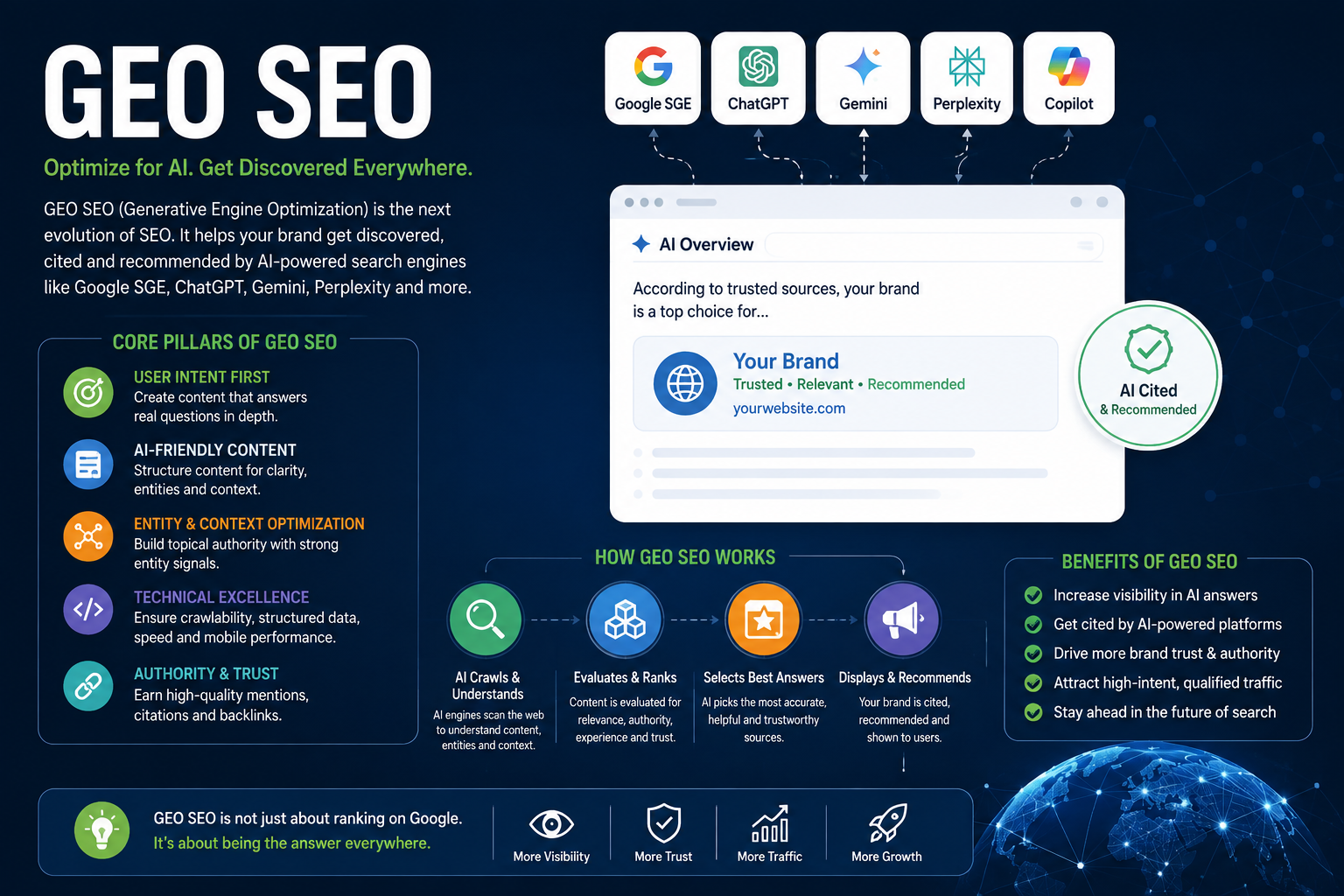
For fifteen years, SEO success meant one thing: rank higher on Google. That equation is breaking. A growing share of search behavior now happens inside AI interfaces — ChatGPT, Perplexity, Google’s AI Overviews, Claude — where there is no ranked list of ten blue links. There’s just one answer, synthesized from multiple sources, often with no click-through at all. Answer Engine Optimization (AEO) and Generative Engine Optimization (GEO) are the disciplines built to earn a place inside that answer.
What AEO and GEO Actually Mean
AEO focuses on structuring content so it can be extracted as a direct answer — think featured snippets, voice search, and FAQ-style responses. GEO is the broader discipline: optimizing your brand’s visibility and citation likelihood across generative AI systems themselves, not just answer boxes. In practice, the two overlap heavily, and most brands need both. The underlying shift is the same: you’re no longer optimizing for a crawler that ranks pages. You’re optimizing for a language model that reads, synthesizes, and cites.
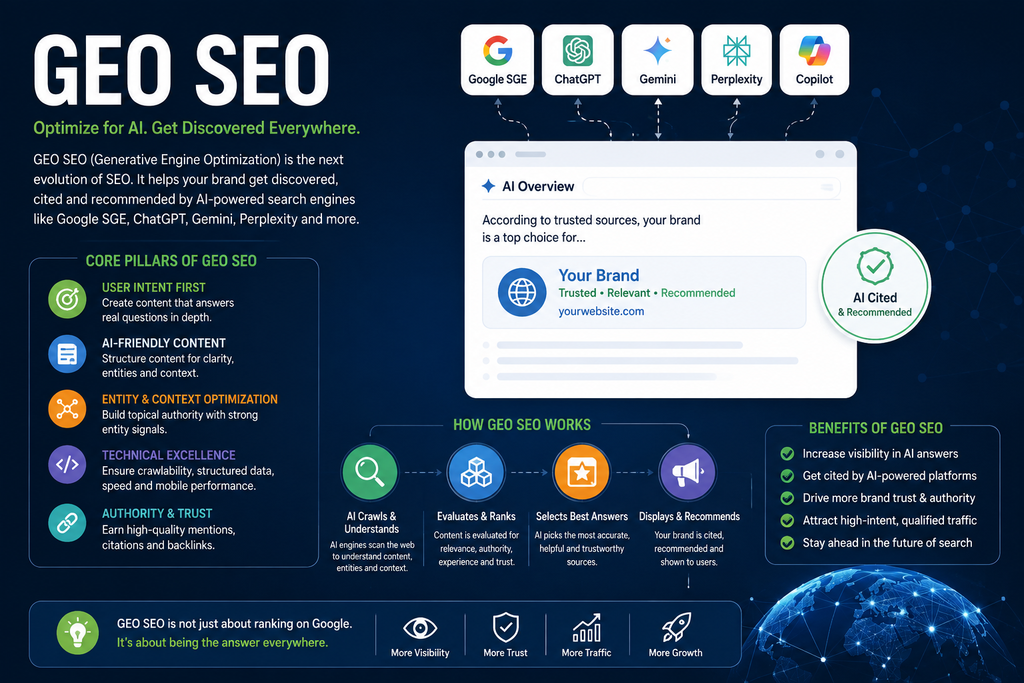
Why Traditional SEO Signals Fall Short
Keyword density, backlink count, and exact-match anchor text were built for a ranking algorithm, not a reasoning one. Large language models weigh things differently:
- Entity clarity — how clearly your brand, product, or expertise is defined and connected across the web
- Source credibility — whether authoritative, frequently-cited domains reference you
- Structured accessibility — whether your content is easy for an AI crawler to parse, not just a human reader
- Consistency of facts — matching claims across your site, third-party mentions, and structured data
A page can rank on page one of Google and still be invisible to an LLM if it isn’t structured for extraction or if the model has no confident entity association with your brand.
The Technical Foundation GEO Still Needs
GEO isn’t a replacement for technical SEO — it’s built on top of it. AI crawlers still need to render and access your content, which is where JavaScript-heavy sites and single-page applications routinely fail. Clean schema markup, canonical clarity, and crawlable HTML remain non-negotiable. What changes is the layer above that foundation: structured data that establishes entities explicitly, FAQ and how-to markup that maps to conversational queries, and content written to answer a question completely within the first few sentences rather than building toward it.
Measuring What You Can’t See in Search Console
The hardest part of GEO right now is measurement. There’s no equivalent of rank tracking for “how often does ChatGPT cite my brand.” Teams are solving this with a mix of manual prompt testing, emerging tools like Otterly.AI, and custom visibility scoring — tracking how often a brand or its competitors appear across a fixed set of representative prompts over time. It’s imperfect, but it’s the closest thing to a leading indicator we have today.
The Real Shift: From Ranking to Being Trusted The deeper change GEO demands isn’t tactical, it’s strategic. AI systems favor sources that read as inherently trustworthy — well-structured, factually consistent, and clearly attributed. Brands that treat GEO as a checklist of new tags will lag behind those that treat it as a reason to fix entity consistency, source credibility, and content clarity everywhere. Google rankings got you visibility. GEO now decides whether you get cited at all — and that’s a much higher bar.
No responses yet